
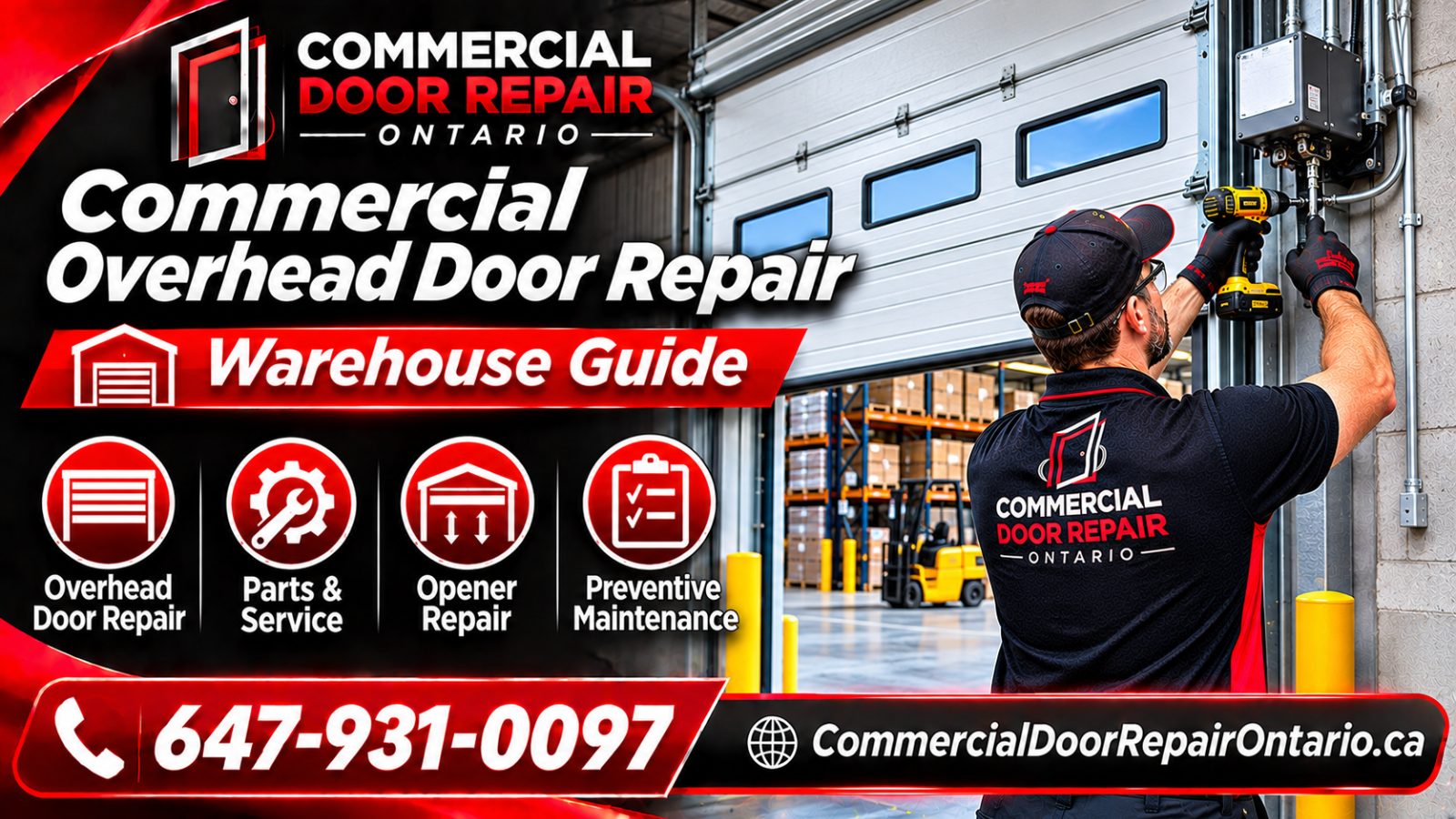
At a warehouse, plant or service garage, the overhead doors are the heartbeat of the building. Every delivery, every shipment and every vehicle goes through them, and when one jams half-open, goes off track or will not close at the end of the day, operations stop and the building is exposed. This guide is written for facility and warehouse managers in the GTA: how commercial overhead and roll-up doors work, the problems that cause most breakdowns, what is safe to check yourself, and how preventive maintenance keeps doors running.
Types of commercial overhead doors
Sectional overhead doors
Sectional doors are made of hinged horizontal panels that roll up on tracks and park under the ceiling. They are common at loading docks, service bays and warehouses, and are available insulated for heated buildings. They are balanced by torsion springs above the opening.
Rolling steel doors and roll-up doors
Rolling doors are made of interlocking steel slats that coil around a barrel above the opening. They take little headroom and are very durable, making them common on storefront security shutters, service counters and industrial openings.
High-speed and specialty doors
Some facilities use high-speed fabric doors, insulated cold-storage doors or fire-rated rolling doors. These need specialized service, but the principles of balance, guidance and safe operation are similar.
How the system works
A commercial overhead door is heavy — often hundreds of kilograms. It is balanced by springs so that the operator or a person can move it easily. Cables transfer the spring force to the bottom of the door, rollers guide it in the tracks, and the operator (motor) opens and closes it, with safety devices such as photo eyes and reversing edges to prevent injuries. When any part of that system wears out, the door becomes unbalanced, noisy, slow, or unsafe.
The most common breakdowns
Broken torsion springs
Springs are rated for a certain number of cycles. On busy doors that can mean failure every few years. A broken spring makes the door extremely heavy; the operator may strain or the door may not open at all. Spring replacement must be done by a trained technician — the stored energy is dangerous.
Frayed or snapped cables
Cables wear where they wrap around drums and can fray or snap, causing the door to hang crooked or drop on one side.
Off-track doors
Impacts from forklifts and trucks, worn rollers, or loose track brackets let rollers jump the track. A door off track can fall and should not be operated.
Damaged panels or slats
Truck and forklift impacts bend panels and slats. Bent sections bind in the track and stress the rest of the door.
Worn rollers and hinges
Grinding, banging and jerky movement usually mean worn rollers and hinges. Replacing them restores smooth operation and reduces wear on springs and the operator.
Operator and safety device problems
Doors that reverse for no reason, stop partway or will not respond often have misaligned photo eyes, damaged reversing edges or worn operator parts.
Worn bottom seals
Daylight, drafts and water under the closed door mean the bottom seal is worn or the door is not closing evenly — a big heating cost in winter.
What is safe to check yourself
- Look for visible damage: bent panels, kinked tracks, frayed cables.
- Listen for new grinding, scraping or banging noises.
- Check that photo eyes are clean and aligned (indicator lights steady).
- Keep the door path and tracks clear of debris, ice and stored items.
- Watch the door close: it should travel evenly and stop gently on the floor.
Do not adjust springs, loosen spring hardware or remove cables. Do not use a door that is off track, hanging crooked, or has a broken spring or cable.
Preventive maintenance pays for itself
Most emergency calls on overhead doors could have been avoided with regular inspection. A preventive maintenance visit typically includes:
- Inspecting springs, cables, drums and bearings for wear.
- Checking and lubricating rollers, hinges and bearings.
- Tightening track and hinge fasteners.
- Checking door balance and operator force settings.
- Testing photo eyes and reversing edges.
- Inspecting seals and weatherstripping.
For facilities with many doors, a maintenance schedule — quarterly or twice a year depending on traffic — reduces downtime and extends door life. See our commercial door maintenance program.
Repair or replace?
Springs, cables, rollers, hinges, sections, seals and operators can all be replaced individually, and most doors can be kept running for many years. Replacement is worth considering when multiple sections are damaged, the door is very old and parts are hard to source, the door is constantly breaking down, or you need better insulation, speed or security.
Don’t forget the man doors and dock equipment
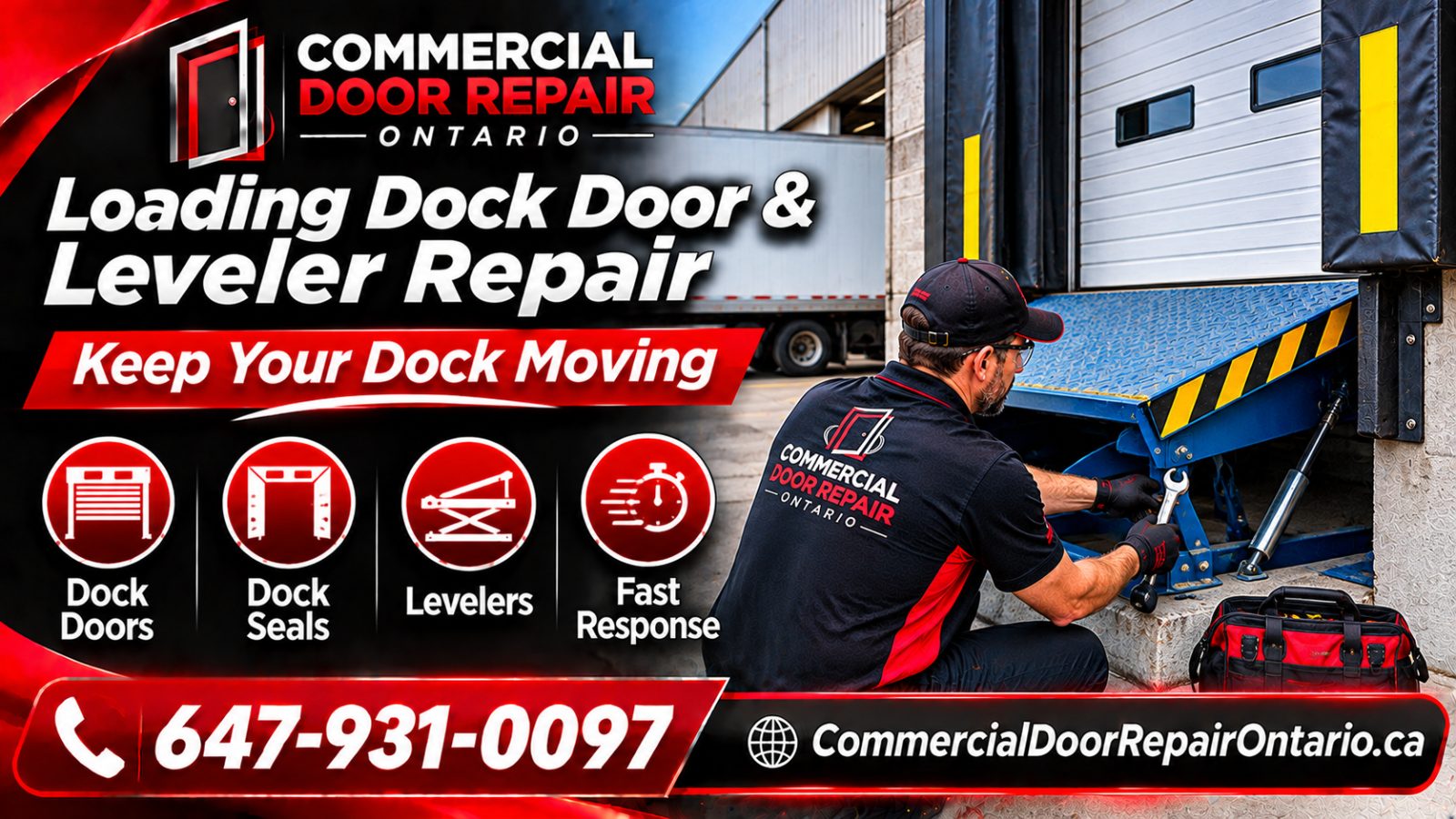
Overhead doors are usually paired with steel man doors and dock equipment. Rear steel doors next to loading areas take a lot of abuse — see our hollow metal door and frame guide — and dock doors, levelers and seals need their own care: see loading dock door repair.
Commercial overhead door repair across the GTA
We repair overhead and roll-up doors at warehouses, plants and service buildings across the region, including Mississauga, Brampton, Hamilton and Waterloo. See also our main overhead and roll-up door repair page.
Frequently asked questions
How long do commercial overhead door springs last?
It depends on the spring’s cycle rating and how often the door is used. On busy commercial doors springs may need replacement every few years; high-cycle springs last longer.
Can I keep using a door that went off track?
No. A door off its track can fall and cause serious injury or damage. Stop using it and call for repair.
Is it safe to replace an overhead door spring myself?
No. Springs store a large amount of energy and can cause severe injury. Spring work should only be done by trained technicians.
Can a single damaged panel be replaced?
Often yes, if matching sections are available. Otherwise replacing the door may be more practical.
How often should commercial overhead doors be serviced?
High-traffic doors benefit from inspection at least twice a year; lighter-use doors at least once a year.
Need an overhead door fixed?
Call Commercial Door Repair Ontario at 647-931-0097 or request service.