
Sagging, dragging or misaligned commercial doors? We replace worn pivots, convert to heavy-duty continuous hinges and fix butt hinges torn out of the frame, on aluminum, steel and glass doors across Toronto and the GTA.
Every time a commercial door opens, its full weight swings on a few small points. On a heavy aluminum storefront, a steel back door or a glass entrance, those points take enormous strain from traffic, wind and closers set too strong. Over time, pivots wear, butt hinges loosen and screws pull out of the frame. The door drops, rubs and stops latching.
Hinge and pivot failure is one of the most common reasons a business calls us. It is also one of the most important to fix early, because a door that drops far enough can come off its pivots entirely.
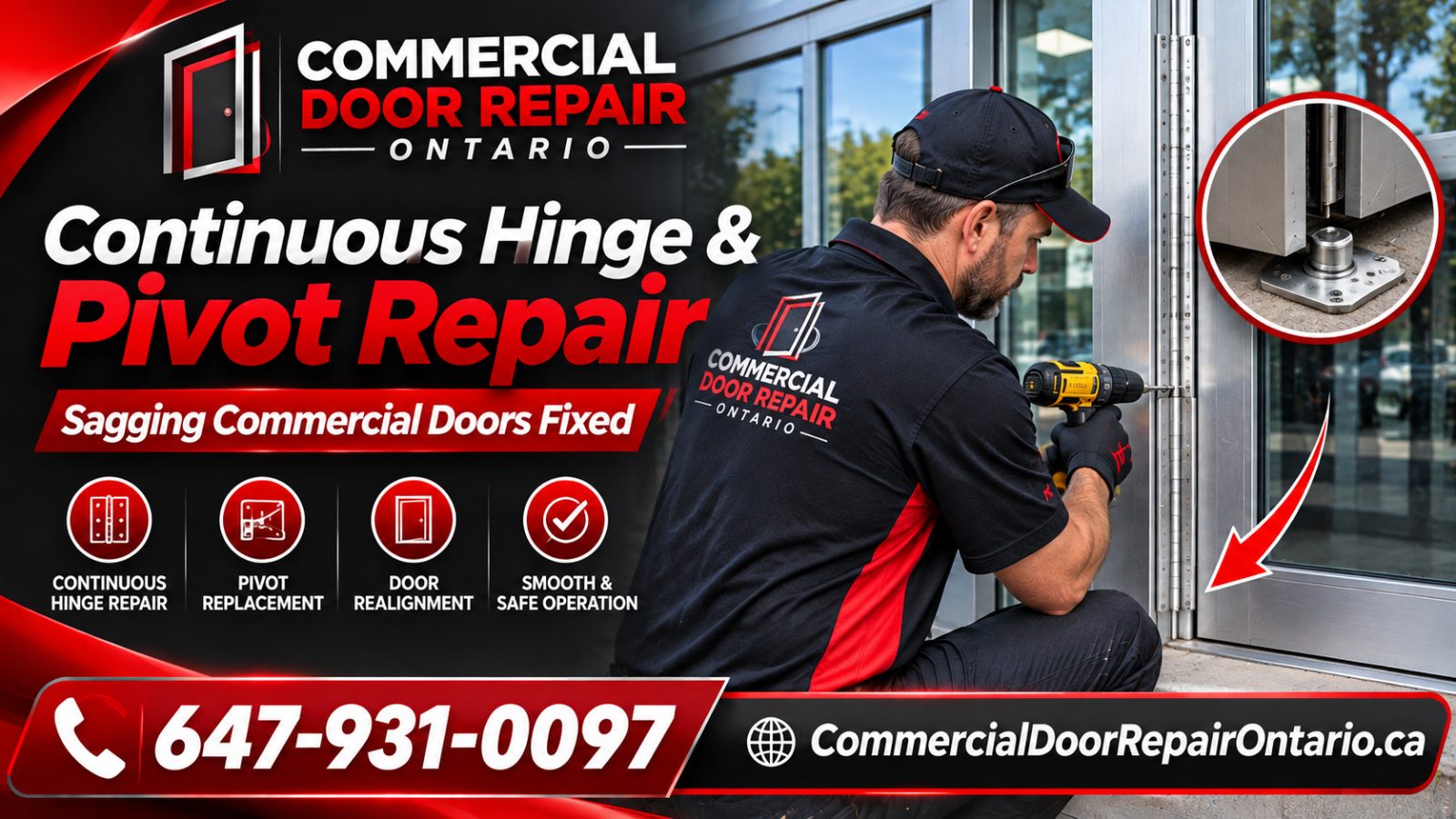
A worn bottom pivot or sagging hinges lower the latch side of the door until it scrapes the floor.
A gap that is wide at the top and tight at the bottom, or the reverse, shows the door has shifted on its hinges.
When the door drops, the bolt misses the strike. Lifting the handle brings it back into line for a moment.
Noises when the door swings usually mean worn pivot bearings or a hinge knuckle that is wearing through.
Screws that keep backing out, or holes that have stripped, mean the frame can no longer hold the hinge.
Any side-to-side movement at the top of the door points to a worn top pivot or arm.
Offset pivots mount at the top and bottom of the door, set just off the frame. They are standard on many aluminum storefronts. We replace worn top and bottom pivots and add intermediate pivots on tall or heavy doors to spread the load.
Centre-hung pivots sit within the thickness of the door and are often paired with floor or overhead concealed closers. They are common on all-glass doors and older entrances. Replacement usually involves the closer spindle as well, so we check both. See commercial door closer repair.
A continuous hinge runs the full height of the door. Because the load is shared along the whole edge, it does not sag the way pivots and butt hinges do. It is our most common upgrade for busy storefronts, schools, clinics and restaurant back doors.
Hollow metal doors usually hang on three or four butt hinges. When the hinge reinforcement in the frame fails, screws pull out and the door sags. We reinforce the frame, replace hinges with heavy-duty ball-bearing hinges, or convert to a continuous hinge. More on hollow metal and steel door repair.

We check the hinges or pivots, how the frame is anchored, and whether the closer is overpowering the door. A closer set too strong will wear new hinges quickly.
Heavy doors are supported while worn pivots or hinges are removed so nothing is damaged.
Stripped screw holes are reinforced, cracked pivot pockets are repaired, and frames that have shifted are corrected. Frame work is covered in more detail on our door frame repair page.
The door is hung square and plumb, with even gaps on all sides.
Once the door hangs correctly, we adjust the closer and check that the lock and latch engage cleanly.
| Pivots | Continuous hinge | |
|---|---|---|
| Load distribution | Concentrated at top and bottom | Spread along the full door edge |
| Typical use | Storefronts, glass doors, concealed closers | High-traffic doors, schools, back doors |
| Sagging over time | More likely as pivots wear | Much less likely |
| Appearance | Nearly invisible | Visible full-height hinge |
| Works with floor closers | Yes | No, uses surface or overhead closers |
Both are good options when chosen for the right door. We recommend based on traffic, door weight, closer type and the condition of the frame.
Front entrances with offset pivots take the most wear. See storefront door repair in Toronto and storefront hinge door replacement.
Steel back doors are opened constantly, often with carts, and are exposed to weather. Butt hinges and frame reinforcements fail first.
High traffic and children leaning on doors make continuous hinges the practical choice.
Hinges on fire-rated doors must be rated for the opening. We fit compliant hardware on fire exit doors and check that the door still closes and latches on its own.

Hinges and pivots fail for predictable reasons. Fixing the cause, not just the hinge, is what makes a repair last.
A closer set to fight wind or a heavy door pulls hard on the hinge side every cycle. Adjusting or upgrading the closer protects the new hinges.
Doors flung open into walls or pushed past their swing with carts lever the hinges out of the frame. Wall stops and overhead stops prevent this.
A gust catching an open door can bend arms and tear hinges. Hold-open closers with limiting stops help on exposed doors.
If the frame is not properly anchored or grouted, it flexes and the hinge screws loosen over time.
Usually yes. Replacing worn pivots or hinges and repairing the frame brings most doors back into line.
Most single-door conversions are completed in one visit of a few hours.
It works with surface and most overhead closers. Doors on floor closers or centre-hung pivots need a different setup, which we explain on site.
A closer set too strong, a door that is too heavy for the pivots, or a damaged frame will wear pivots quickly. We check all three.
Yes, using hinges listed for fire-rated openings.
We offer same-day and 24/7 emergency service. Call 647-931-0097.
Door closer repairPanic bar & exit devicesHollow metal & steel doorsAutomatic door repairOverhead & roll-up doorsLoading dock doorsAluminum door repair TorontoGlass repair & replacementFire exit doorsEmergency door repairCommercial door installationCommercial door replacementDoor frame repairDoor parts & hardwareStorefront hinge replacement Toronto
TorontoNorth YorkScarboroughEtobicokeMississaugaBramptonVaughanWoodbridgeMarkhamRichmond HillThornhillOakvilleBurlingtonMiltonHamiltonPickeringWhitbyOshawaAjaxNewmarketAuroraBarrieKitchenerWaterlooCambridgeGuelph
See the full list on our areas we serve page, or contact us for a quote.