rong>A door closer is the hardest-working piece of hardware on any commercial door, and the one most people only notice when it fails. When a closer goes, the door slams hard enough to crack glass, drifts open in the wind, leaks oil on the floor or won’t pull itself shut, which leaves your business unlocked and, on fire doors, out of code. This guide walks through the most common commercial door closer problems we see across the GTA, what causes each one, what a property manager can safely check, and when a closer needs repair or replacement. For service, see our commercial door closer repair page or call 647-931-0097. Most commercial closers are hydraulic. Opening the door compresses a spring inside the closer body. As the door closes, the spring pushes it back, and hydraulic oil passing through small valves controls how fast it moves. Two or three adjustment valves let a technician set: Closers come as surface-mounted units (on the push or pull side of the door), concealed overhead closers in the frame, and floor closers under storefront doors. The problems below apply to all three, but repairs differ. A slamming door is the most common closer complaint, and it’s a safety issue. It catches fingers, cracks glass, loosens hinges and frames, and on a busy entrance it can hit customers. Look at the closer body and the floor or frame under it. An oily film or drips mean the seals have failed. If there’s no oil, the closer may only need adjusting. If the closer is dry, a technician adjusts the valves a fraction of a turn at a time. Over-turning a valve can push it out of the body and empty the closer, so this is not a job to guess at. If oil is leaking, the closer must be replaced. Leaking closers can’t be refilled. A door that stops a few inches short, or closes but doesn’t latch, is the second most common call. For a business it means an unlocked door overnight. For a fire door it means a code violation. We check the door first, not just the closer. If the door drags, we repair the hinges, pivots or frame. See continuous hinge and pivot repair. Then we set the closer’s spring power and latch speed so the door closes fully every time. Building pressure issues may need a stronger closer or an adjustment from your HVAC contractor. Oil on the closer arm, on the frame, or a dark stain on the floor under a floor closer means the internal seals have failed. A leaking closer gets worse quickly: first the door speeds up, then it slams, then it stops closing at all. Replace. Leaking hydraulic closers are not designed to be resealed in the field. The good news is that most surface closers can be swapped using the same mounting holes or a drop plate, so the door doesn’t need new prep. If staff or customers struggle to push a door open, the closer’s spring power is set too high, or the wrong size closer was installed. This matters for accessibility as well as comfort. Ontario’s accessibility standards limit how much force interior doors should take to open, and many businesses add automatic operators on main entrances. Adjustable closers can often be set to a lower power size. If the closer is fixed-size or the door is too heavy for low force, an accessible door operator may be the right answer. Closer arms take a beating: doors propped open with a wedge, doors kicked open, wind catching a door and throwing it against the arm. A bent arm makes the door close unevenly. A broken or detached arm means the door doesn’t close at all. Arms can be replaced on their own if the closer body is healthy. Where screws have stripped out of a steel frame, we use through-bolts or rivet nuts so the arm stays put. Damaged frames are covered in our hollow metal frame replacement guide. Exterior doors facing open parking lots or loading areas can be pulled open by wind if the closer is undersized or the back check is set too light. When wind catches the door, it can tear the closer arm, the hinges or even the frame. We increase back check, upsize the closer, or add an overhead stop or a heavy-duty parallel arm. For very exposed doors, a closer with a built-in stop or a separate overhead stop protects the hinges and frame. Storefront glass and aluminum doors often use floor closers or concealed overhead closers. When these fail, the door may swing past centre, sag, rock on its pivot or refuse to stay at the closed position. Floor closers sit in a cement case under the door and support its weight, so a failing floor closer often shows up as a door that drags or sits crooked. Water and salt in the floor box shorten their life in Ontario winters. Concealed overhead closers are hidden in the frame header and need the door removed to service. See storefront door repair in Toronto and commercial glass door repair for those door types. A fire-rated door must close and latch on its own. If the closer is missing, disconnected, too slow or held open with a wedge, the door fails inspection. Fire marshals and insurance inspectors look for exactly this. We confirm the closer is the right type for a fire door, that it closes the door fully from any open position, and that the latch engages every time. Hold-opens on fire doors must release on fire alarm. See fire door inspection and repair in Ontario. Closers are rated by size, from small interior doors up to heavy exterior doors. Many modern closers are adjustable across several sizes, which lets us dial in the right force for the door and the location. Regular arm (on the pull side, with the arm sticking out), parallel arm (on the push side, arm folded along the door, more vandal-resistant) and top jamb mounts each suit different doors. On exterior commercial doors in Toronto, a heavy-duty parallel arm is a common choice because it holds up better to wind and abuse. For busy commercial entrances, a Grade 1 closer is the safe choice. Lighter-duty closers on high-traffic doors simply wear out faster. Constant customer traffic, glass doors and wind from parking lots. Floor closers and parallel-arm closers both see heavy wear. See plaza and retail door repair. Stack pressure and HVAC push against lobby doors, so they fail to latch, which is a security problem for residents. See condo lobby door repair. Back doors get propped open, kicked and hit by carts, and kitchen exhaust creates negative pressure that keeps doors from closing. See restaurant back door repair. Man doors next to loading docks take wind, forklifts and dust. Heavy-duty closers and overhead stops help a lot. See loading dock door repair. Closers rarely die overnight. Most give a few weeks or months of warning, and catching it early means a planned replacement instead of an emergency call on a Friday night. Property managers often ask why they shouldn’t just turn the valves themselves. Here’s what a proper visit looks like, and why the order matters. We swing the door with the arm disconnected. If the door drags, binds or swings on its own, no closer setting will fix it. Hinges, pivots and the frame come first. We check that the closer is the right size for the door’s width, weight and exposure, and that it’s mounted where the manufacturer’s template says. A closer mounted an inch off the template can lose a lot of its power. On adjustable closers we set spring power to the lowest setting that still closes and latches the door reliably, which keeps opening force reasonable. Small turns, test, repeat. Each valve affects a different part of the swing. We finish when the door closes smoothly from fully open in a few seconds and latches without a slam. If HVAC is running, we test with it on. On exterior doors we check what happens when the wind catches the door. A setting that works with the building quiet can fail at rush hour. We quote after seeing the door, but these are the factors that drive the price: Closer checks fit naturally into a commercial door maintenance program along with your winter maintenance checklist. A closer works with the rest of the door. If you’re dealing with closer problems, it’s worth checking the hardware around it too: We repair and replace commercial door closers across Toronto and the GTA, including North York, Markham, Richmond Hill, Vaughan, Brampton and Mississauga. See all commercial door services by city. The closer’s speed is set too fast, or the closer is leaking oil and can no longer slow the door. If there’s oil on or under the closer, it needs replacing. No. Once a hydraulic closer leaks, it should be replaced. Most can be swapped using the existing mounting holes. Usually low latch speed, a dragging door from worn hinges, a misaligned strike or air pressure from the building’s HVAC. We check the door and the closer together. Hydraulic oil changes with temperature, so a closer set in summer can be slower in the cold. A seasonal adjustment fixes it. Yes. Fire-rated doors must be self-closing and self-latching. A missing or disconnected closer is a common inspection failure. Slamming, leaking or doors that won’t latch? Call Commercial Door Repair Ontario at 647-931-0097 or contact us. We’ll check the door, the closer and the hardware together and tell you exactly what it needs. Full service details are on our commercial door closer repair page.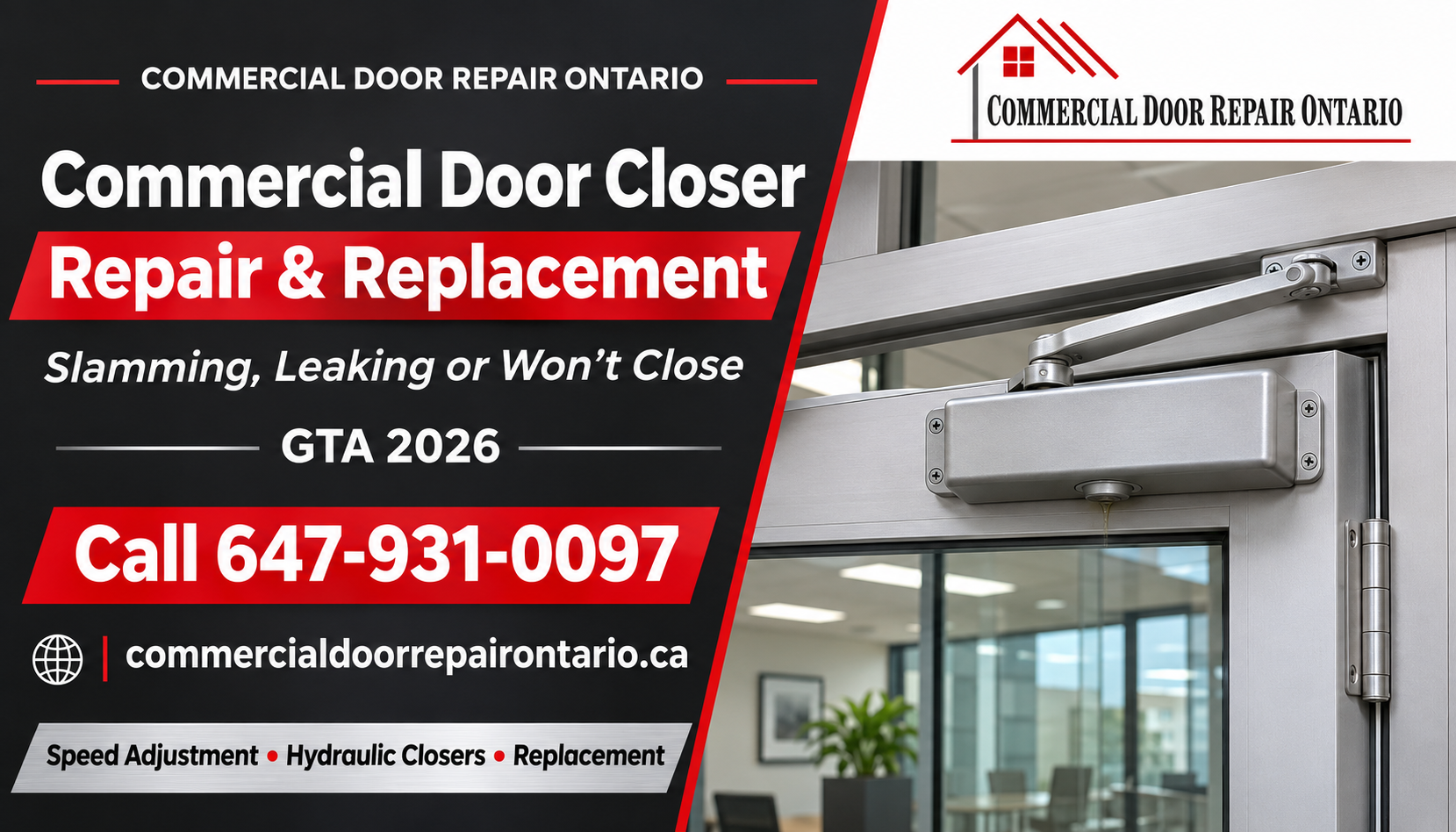
How a commercial door closer works
Problem 1: The door slams shut
What causes it
What you can check
The fix
Problem 2: The door won’t close or latch
Usual causes
How we fix it
Problem 3: The closer is leaking oil
Repair or replace?
Problem 4: The door is too hard to open
What we do
Problem 5: The arm is bent, broken or detached
Common arm issues
The fix
Problem 6: The door drifts open in the wind
How to stop it
Problem 7: Floor closer and concealed closer failures
What’s different about them
Problem 8: Fire door closers that don’t do their job
What we check
Closer repair vs. replacement: a quick guide
Usually an adjustment or repair
Usually a replacement
Choosing the right replacement closer
Size and strength
Mounting style
Grade
Closer problems by type of building
Retail plazas and storefronts
Condo and apartment lobbies
Restaurants
Warehouses and industrial units
Early warning signs a closer is about to fail
What a closer adjustment actually involves
1. Check the door before the closer
2. Confirm size and mounting
3. Set spring power
4. Set sweep, latch and back check
5. Test in real conditions
What affects the cost of closer repair or replacement
Door closer maintenance checklist
Related commercial door hardware
Door closer repair across the GTA
Commercial door closer FAQ
Why does my commercial door slam?
Can a leaking door closer be repaired?
Why won’t my door close all the way?
Why does my door close differently in winter?
Do fire doors need a closer?
Book commercial door closer service
